Campus Weather


Where Does the Money Come From?
Understanding How Hillcrest Academy Is Funded: A Message to Our Hillcrest Community — Families, Church Partners, and Friends
Every year, families entrust Hillcrest Academy with something precious: their children, their time, and their financial support. In return, we owe you clarity and honesty. Clarity about what it actually costs to run our school, and honesty about where the money to do that comes from.
The short answer is that no single source fully funds Hillcrest. We operate through a layered model — tuition paired with Education Savings Accounts, support from our partnering local congregations, and an Annual Fund that fills the gap between what we charge and what it costs to deliver an education worth giving. Understanding how these three pieces fit together helps explain why each one matters and why the whole model depends on all three working together.
What It Actually Costs
Before talking about where money comes from, it helps to start with where it goes.
Running a non-public school like Hillcrest Academy means paying and retaining excellent teachers, maintaining our facilities, providing the curriculum and resources our students deserve, and keeping the school financially healthy. All these pieces together carry a real per-student cost. The full cost of education is the number we work backward from when we design our budget each year. It represents what Hillcrest actually needs, per child, per year, to operate with integrity. The cost of education for a high school student at Hillcrest Academy for the 2026-27 school year is $17,141, and for a Hillcrest middle school student, it’s $14,841. In comparison, the cost of education for a high school student at Mid-Prairie next year will be $18,160 per student.
The honest reality of a non-public, Christian education is that the full cost of education almost always exceeds what families can reasonably be asked to pay in tuition alone. That gap is not a sign of financial mismanagement, but a structural feature of mission-driven education, and closing it faithfully is the work of our entire community.
Piece One: Tuition with Education Savings Accounts
The foundation of our funding is the direct family contribution. This comes from tuition which is often coupled with an Education Savings Account (ESA).
Iowa’s ESA program allows eligible families to direct a portion of the state per-pupil funding toward a school of their choice, including Hillcrest. For families who qualify, this is a meaningful contribution toward their tuition obligation. Families are able to take the $8,148 and apply it directly toward their student’s tuition, making their education more manageable financially. Hillcrest also offers financial assistance to those families who still need support.
One of the most meaningful things the ESA program does is lower the financial barrier to enrolling at Hillcrest in the first place. Because ESA funds are available to any eligible Iowa family, a Hillcrest education is no longer limited to families who can absorb a non-public school tuition on their own. Families across a wide range of income levels and circumstances can make Hillcrest an option for their children. That is no small thing. It means our school can be what we believe it should be: a community open to any family who shares our mission and wants to apply, regardless of their situation. The result is a student body that is more diverse than we’ve ever been and much different than what you typically find in other independent Christian schools. It’s that diversity which makes Hillcrest a richer, truer reflection of our mission and of the broader local community we serve.
However, and this is the critical point, when a family receives ESA funds and applies that to their tuition, this typically does not reach the full cost of educating that student. There is still a gap. That gap is real, and it has to be funded somehow. Hillcrest Academy high school tuition for the 2026-27 school year is $13,400, and for a Hillcrest middle school student, it’s $11,200.
Piece Two: The Annual Fund
Even with family tuition (including ESA contributions) and local congregational support combined, a gap typically remains between revenue and what it actually costs to operate Hillcrest at the level our students deserve. That gap is why the Annual Fund exists as part of our budget.
The Annual Fund is our school community’s annual, collective act of generosity. It is not restricted to a specific project or a future building; instead, it goes directly toward the operating costs of the school in a particular school year. Every dollar given to the Annual Fund is put to work immediately: supporting faculty and staff salaries, enabling programs, and ensuring that the school can operate without compromising on quality.
Think of it this way: tuition covers the family’s share, the Congregational Support Plan represents the church community’s share, and the Annual Fund is where everyone has the opportunity to close the remaining distance between what we charge and what it costs. This includes families, alumni, grandparents, friends of the school, and community members who simply believe in the mission of Hillcrest Academy. When the Annual Fund is strong, the school can plan with confidence, retain excellent faculty and staff, keep up with maintaining our beautiful campus, and serve students without compromise.
Piece Three: The Congregational Support Plan
From its beginning, Hillcrest Academy has existed within a community of faith. Since 1945, we, along with our supporting churches, have had a shared mission. The Congregational Support Plan is the formal expression of that partnership.
Through the Congregational Support Plan, the seven-member congregations make a committed, annual financial contribution to the school. This is a structured commitment that congregations budget for and fulfill year after year. Each participating church is essentially saying, ‘We believe in what Hillcrest is doing, and we are willing to put our congregation’s resources behind it.’
This support does several things at once. It reduces the financial investment for individual families, making a Hillcrest education more accessible. It keeps tuition from having to bear the full weight of the school’s costs. And it connects the school to something larger, a network of congregations that have put their own resources behind the mission of Hillcrest. The CSP is not a bonus on top of a fully funded school. It is a load-bearing part of the structure.
The Full Picture
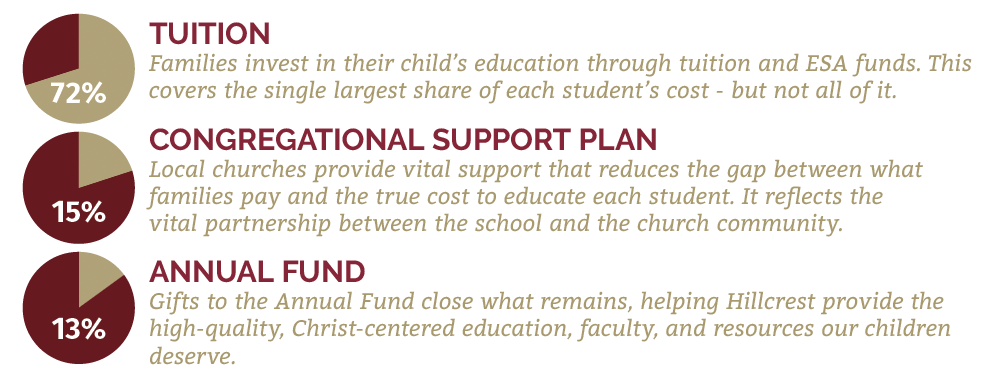
None of these three pieces are optional. Take any one of them away, and the model breaks. We share this to hopefully create better transparency about how Hillcrest Academy is funded and because you deserve to understand what you’re part of.
It’s also important to understand what these three pieces of funding do not cover. Together, family contributions, congregational support, and the Annual Fund are designed to get Hillcrest to the point of breaking even on day-to-day operations and keeping the school running as it should. Of that operating budget, roughly 78% goes directly to salaries and benefits for the teachers and staff who make Hillcrest what it is. This is a reflection of that first and foremost, Hillcrest is an investment in people. These three pieces are not designed to fund building renovations or additions, major non-routine maintenance and repairs, or other significant improvements to our campus and facilities. Those kinds of projects fall outside the operating budget entirely and require separate, dedicated fundraising. When you hear about a capital campaign or a special project appeal, that is why: because it’s a different need, funded in a different way, on top of the operating model described here.
Every family that enrolls, every congregation that gives, and every person who contributes to the Annual Fund is actively holding up our school together. That is something worth understanding. And it is something worth being proud of.
Questions about Hillcrest’s finances or how to give to the Annual Fund? Contact the Office of Advancement — we’re glad to talk through any of this in more detail.